How to figure out what to share, what to keep to yourself, and how your answer will change over time.
In This Guide
Privacy but no secrets.
Transparency is one of the trickiest parts of non-monogamy. Too little erodes trust. Too much, and you create anxiety, comparison, or hurt.
My husband and I have been openly committed for over 15 years, and we still regularly check in on transparency around how much I tell him about what I've done with other people, how much he tells me, and what each of us actually wants to know in any given season. We have a phrase he coined many years ago: privacy but no secrets.
The idea is simple: you don't need to share every detail to be honest. But you do need to agree that there's nothing hidden, nothing either of you would feel betrayed by finding out later.
Figuring out where that line sits for your relationship is some of the most important work you'll do.
"If I'm Not Telling You Everything, Am I Hiding Something?"
Withholding isn't the same as hiding. Trust is built through honesty, not through knowing everything.
This is the fear I hear most often, and one I still wrestle with myself.
A Moment That Reframed It for Me
I went on a date that Rich knew about in advance. When I got home, I wanted to tell him everything! I tend to overshare in all things. I wanted to tell him what I ate, what happened, how I felt, all of it. And he said, "Danielle, I'm really happy you had a good time. I love that we give each other this freedom. But right now, I don't want to know the details."
I have always worried that if I wasn't telling him everything, I was hiding something. But withholding isn't the same as hiding. Trust is built through honesty, not through knowing everything. Honesty means you won't conceal something that affects your partner. It doesn't mean your partner has a right to every thought, every detail, every moment.
That distinction is helpful in any relationship, but especially a non-monogamous one.
Levels of Transparency Change.
What matters isn't where your line sits today. It's that you've talked about where it is, and that you keep talking about it as it moves.
Transparency isn't a one-time agreement you sign and file away. It shifts based on what each of you is going through, what's happening in the relationship, and how much trust you've built.
Early on, most couples need more transparency, not less. You're establishing trust, testing agreements, and learning what each of you can actually hold. Sharing more builds the foundation. Later, once trust is deep and you both know the structure works, you can often afford more privacy. I would also recommend more transparency after trust has been broken or a mistake has been made (yes, mistakes happen!).
That's not a rule, though. Your line might shift the other way, too. The partner who wanted every detail in year one might want almost none in year five. The partner who was happy not knowing might suddenly want to know more after a hard season. Both are normal.
What matters isn't where your line sits today. It's that you've talked about where it is, and that you keep talking about it as it moves.
Three Tools That Help
Figuring out the right level of transparency is hard, and it's even harder in the moment! Like when emotions are high, or when one of you has just walked in the door from a date. These are three tools Rich and I use and recommend.
1. Time-Box the Hard Conversations
Don't let the big conversations about dates, partners, or agreements happen by ambush! On the way out the door, in the middle of dinner, right before a work presentation or special event. Instead, agree on a time and a place.
"Saturday morning, coffee on the porch, 30 minutes" is a complete plan.
It tells both of you: this is when we talk about it, and it's not going to take over the whole weekend.
Time-boxing does two things. It gives the person who needs to share a clear window to do it, so they're not sitting on information that feels heavy. And it gives the person receiving the information a chance to prepare — mentally, emotionally, logistically — instead of being caught off guard. The same way you'd want a heads-up before a big meeting or a long conversation with a parent, you want one here.
2. Let the Person Who Wants to Know Less Ask the Questions
This one is simple, and it's a game-changer.
When one of you has more to share than the other wants to hear, flip the default. Instead of the returning partner telling their story, the listening partner asks the questions.
High-level first: "Did you have a good time?" "Are you okay?" "Is there anything I need to know?" And from there, they go as deep as they want. Or they stop.
Two Rules That Make This Work
The asker has to actually be ready for the answers. Don't ask questions you don't want the real answer to.
The answerer has to answer only what's asked. Not what you wish they'd asked. Not what you're excited to share. The actual question.
You'd be amazed how often someone asks one question and gets a different, bigger one answered (um… speaking from personal experience here). Resist that. Trust that if your partner wants more, they'll ask.
3. Use a Traffic Light in Real Time
Even with the best planning, conversations shift. Someone asks a question, the answer opens a door neither of you expected, and suddenly one of you is overwhelmed and the other doesn't realize it.
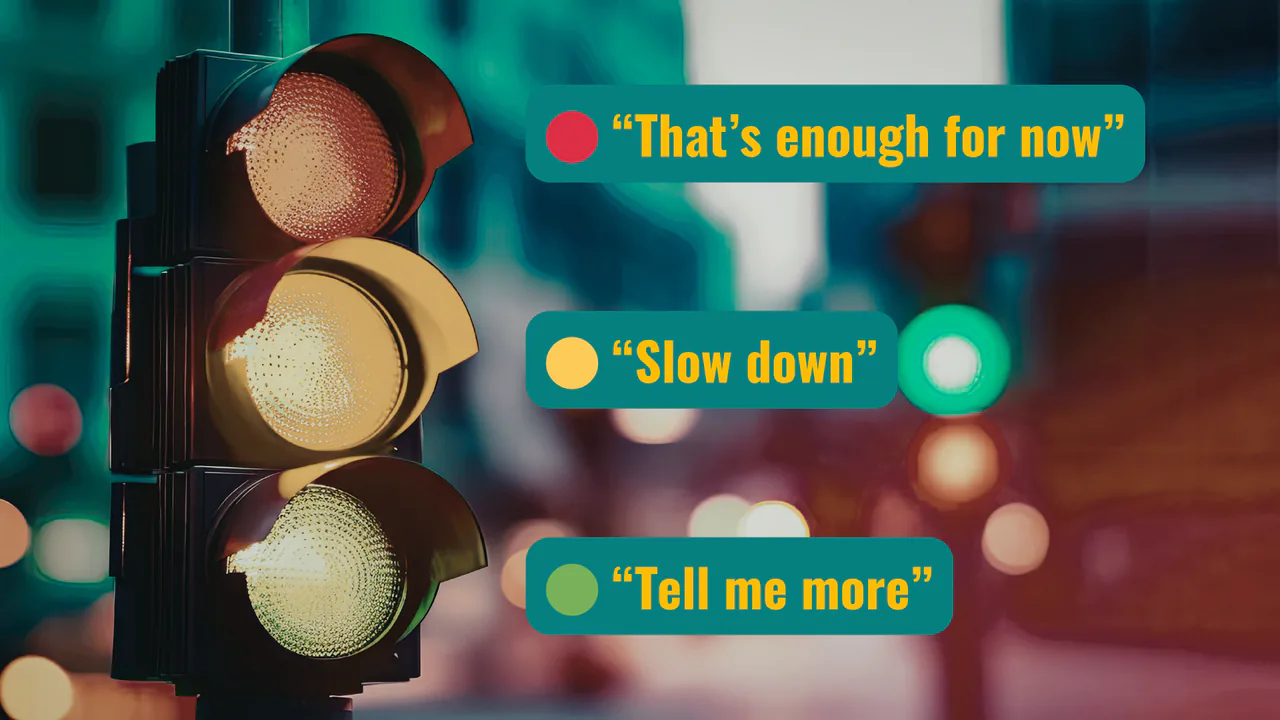
The traffic light is a real-time signal. As the conversation unfolds, the listener can check in with themselves and name where they are.
Green — "Tell me more."
I'm okay. Keep going.
Yellow — "Slow down."
I'm getting close to my edge. Pause, check in, ease up.
Red — "That's enough for now."
I have what I need. Let's stop here. We can come back to it later.
This does two things at once. It gives the listener permission to stop the conversation without shutting it down — red isn't "no, never," it's "enough for today." And it gives the person sharing a clear read on what their partner can actually hold, so they stop having to guess.
Over time, you get faster at catching yellow before it turns red. That's the skill.
One More Thing: Your Partners' Privacy Isn't Yours to Share
"Privacy but no secrets" applies to your relationship with your partner. It doesn't give either of you the right to share what your other partners have told you in confidence.
If someone you're dating tells you something vulnerable (about their marriage, their health, their history) that's theirs, not material for pillow talk at home. The same goes in reverse: your partner's dates are entitled to the same discretion.
The Work Is the Point
Privacy but no secrets isn't a destination you arrive at. It's a conversation you keep having.
After 15 years, Rich and I still get it wrong sometimes. I still over-share when he wants less details. The difference is we've built enough practice — and enough trust — to notice quickly, name what's happening, adjust.
That's what I want for you. Not a perfect rulebook, but a few tools, and the willingness to keep checking in as the relationship grows.